
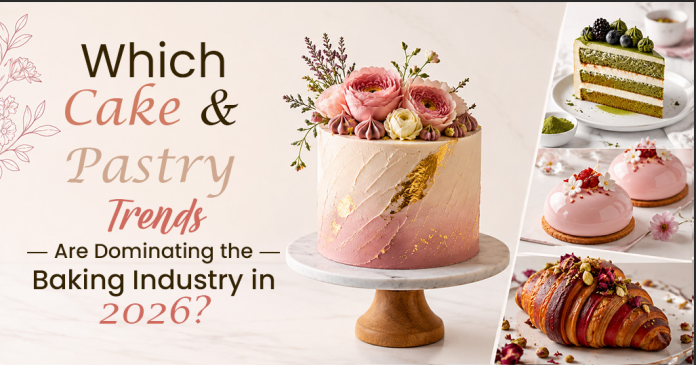


There is a particular moment many bakers remember clearly. Standing in front of a finished cake, wondering whether what they just made still feels relevant. Not technically flawed. Not poorly decorated. Just quietly out of step with where the industry seems to be heading. That feeling is more common than people admit, and it is often the beginning of something useful.
The baking industry in 2026 is not chasing novelty for its own sake. It is doing something more interesting. It is returning to intention. From the rise of fermented pastry doughs to hyper-personalised celebration cakes, from the growing demand for texture-forward desserts to the quiet dominance of earthy and floral flavour profiles, the trends shaping this year reflect a deeper shift in how people relate to food. Those enrolled in the Best Baking Classes in Chennai are already beginning to see how structured training connects directly to this evolving landscape. This blog takes a closer look at which trends are defining the industry right now, what is driving them, and how a serious baker can build lasting relevance in a market that keeps moving.
Fermented Doughs Are No Longer a Niche
Sourdough’s moment has stretched well beyond the pandemic kitchen. What began as a lockdown project has evolved into a professional standard. In 2026, fermented pastry doughs are showing up in croissants, Danish layers and even brioche-adjacent formats that carry a subtle tang without compromising richness.
Why does this matter? Because fermentation changes the very character of a dough. It builds complexity over time rather than through additives. For the trained baker, understanding fermentation is not just a trend to follow. It is a technique that shapes every bite.
Texture Has Become the New Flavour
Taste was never the whole story. But in 2026, that truth has finally caught up with the dessert world and what a pastry feels like in your mouth is now as much a part of the experience as the flavour itself. The contrast between a crackling caramelised shell and a yielding interior. The resistance of a well-tempered chocolate coating against a mousse that barely holds its shape. These are deliberate choices, not happy accidents.
The industry is asking its bakers to think in layers of sensation. Achieving that requires a foundation in both theory and repetitive hands-on practice, because texture is unforgiving. You either hit it or you do not.
Botanical and Earthy Flavour Profiles Are Holding Strong
Lavender, rose, cardamom, and black sesame have been circling the margins of mainstream baking for years. In 2026, they are no longer garnishes or afterthoughts. They are centrepiece flavours. Customers who once ordered vanilla without a second thought are now drawn to pastries that carry depth, warmth, and something they cannot quite name on the first bite.
This shift rewards bakers who understand balance. Too much lavender and it reads like soap. Too little and the intention disappears entirely. Learning to work with botanicals is a quiet skill, and it separates the instinctive baker from the technically confident one.
Hyper-Personalisation in Celebration Cakes
The celebration cake market has undergone a significant transformation. In 2026, customers are arriving with mood boards, cultural references and requests that blend artistic influences across generations. The demand is no longer for a beautifully decorated cake in a familiar style. It is for something that tells a specific story.
This builds pressure on bakers to develop range. A sculptor’s precision, a colourist’s eye, and an understanding of structural integrity all come into play simultaneously. The trend is exciting, but it is also technically demanding in ways that self-taught practice alone rarely prepares you for.
Sustainability Is Shaping Ingredient Choices
There is a growing awareness in the industry about sourcing. Customers are asking where ingredients come from. Bakeries are reconsidering single-use elements in their displays and packaging. And in competition circuits, judges are beginning to factor in the thoughtfulness behind ingredient selection.
This is not a marketing conversation. It is a craft conversation. Understanding how a locally sourced grain behaves differently from a standard imported flour, or how the fat content of seasonal cream shifts a ganache, is genuine knowledge. It changes how you work, not just how you speak about your work.
Minimalist Aesthetics With Maximum Precision
In sharp contrast to the maximalist decorated cakes of recent years, 2026 is seeing a strong return to restraint. Clean lines. Muted palettes. Surfaces that reveal skill rather than conceal it. A bare layer cake with impeccable crumb and perfectly levelled tiers says more than an over-adorned structure.
This trend is humbling for many bakers. Decoration can hide a great deal. Minimalism cannot.
For anyone serious about staying ahead of these shifts, the path runs through structured learning. Institutions like Zeroin Academy, a well-regarded baking classes in Chennai Velachery , approach training with exactly this in mind. Not trends for their own sake, but the technical grounding that allows a baker to meet any trend with confidence.
That moment of standing in front of a finished cake and wondering if it still feels relevant? It does not go away entirely. But it gets quieter the deeper the craft goes.